A virtual hug is any digital gesture, from an emoji or GIF to an avatar animation, haptic pulse, or VR interaction, that symbolically conveys the warmth and closeness of a real embrace. It is a signal of care, not a substitute for physical touch.
You might send 🤗 after a friend says they’re having a difficult day. You might receive a hug GIF from someone who lives far away, watch a streamer make an embracing gesture toward the camera, or meet an avatar in a virtual world that responds with a simulated hug. The action looks simple, but the experience can range from a visual symbol to a carefully designed combination of sight, sound, and touch.
That range creates the central question: what is a virtual hug really doing? It can acknowledge pain, mark affection, strengthen a community ritual, or invite someone to keep talking. It can also feel automatic, awkward, or intrusive when the context is wrong. If distress is more serious than a passing bad day, a digital gesture should sit alongside meaningful human support, such as help for depression from Interactive Counselling, rather than replace it.
Table of Contents
- A Hug That Travels Through a Screen
- Defining a Virtual Hug Across Every Medium
- Comparing Emoji Hugs, Avatar Hugs, and VR Hugs
- Virtual Hugs in Streams, Discord, and Social Feeds
- When a Virtual Hug Helps and When It Misses
- Etiquette, Consent, and a Practical Rule of Thumb
A Hug That Travels Through a Screen
A familiar scene starts with a notification. Someone you care about writes, “Today has been awful,” and you pause before replying. You can type a sentence, call them, send a heart, or choose the small face with open hands, 🤗. The emoji takes almost no effort, yet it communicates something that plain text may not: I’m responding with warmth, not just information.
That doesn’t make the symbol meaningless. People use small digital gestures to soften difficult conversations, celebrate good news, and remind distant friends that they’re present. A GIF can add movement and humor. A video call can add facial expression and voice. An avatar can turn the gesture into an action inside a shared world.
The same gesture carries different weight
A virtual hug between close friends usually carries a different meaning from one sent by a stranger in a public chat. The recipient reads the relationship, the timing, the wording around the gesture, and the platform itself. A hug emote in a busy livestream may be a community greeting, while the same image in a private conversation about grief may feel too light.
Practical rule: Treat the virtual hug as a signal that opens a conversation, not as proof that the conversation is finished.
The medium matters because each format offers a different kind of presence. An emoji is quick and widely accessible. An animated avatar can show intention and movement. Haptic technology can add physical sensations, but only through devices that encode and deliver those sensations. None of these formats reproduces another person’s body, warmth, breathing, or judgment in the moment.
What this idea helps you notice
Thinking about virtual hugs as communication signals makes ordinary online behavior easier to understand. It explains why a single emoji may comfort one person and annoy another, why a streamer’s spoken acknowledgment can matter more than a triggered emote, and why an immersive avatar gesture needs stronger boundaries than a text symbol.
The useful question isn’t whether a virtual hug “works.” Ask what the sender is trying to communicate, what the recipient is likely to understand, and what human follow-up should come next.
Defining a Virtual Hug Across Every Medium
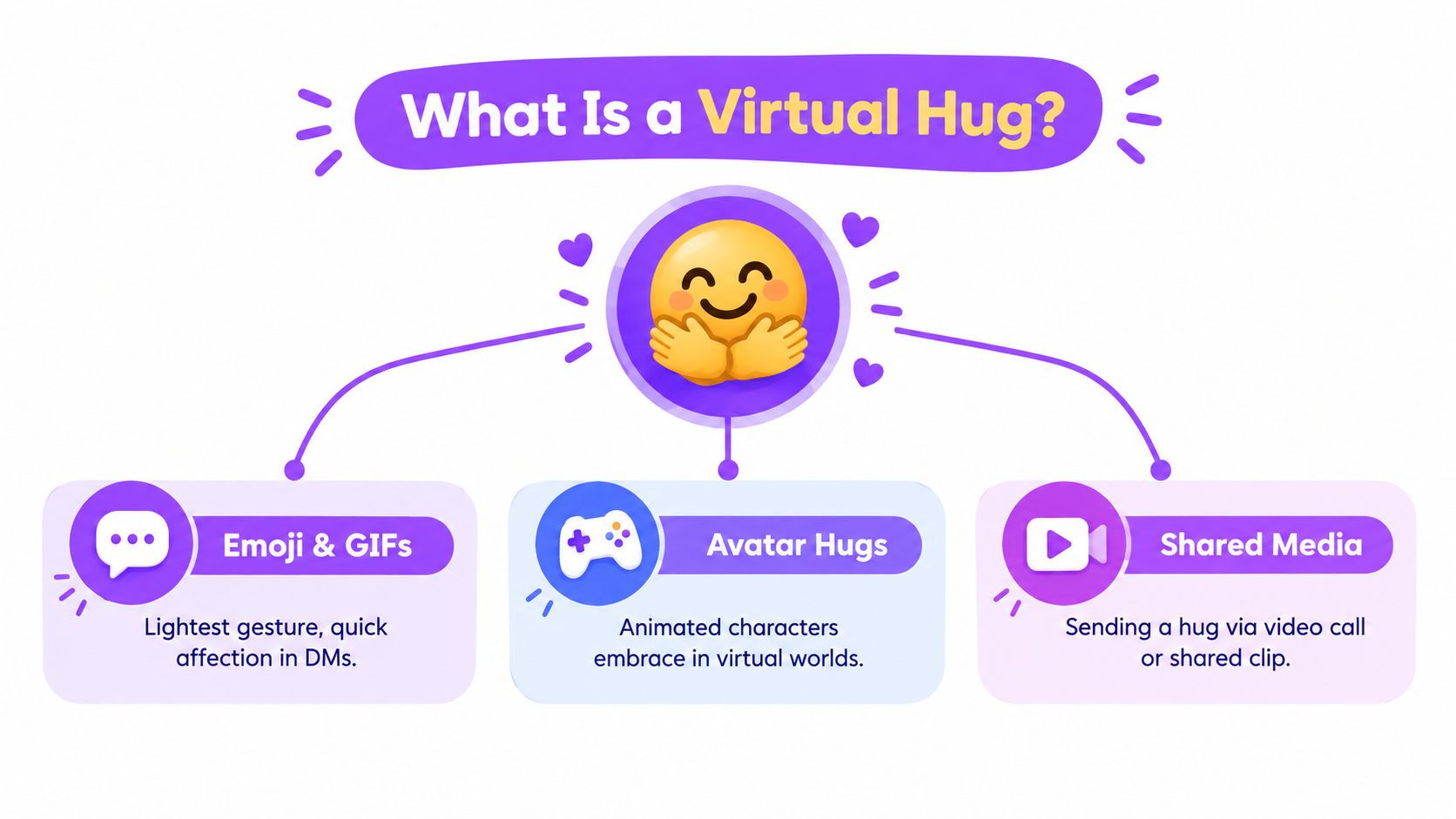
Start with the lightest version. An emoji hug or GIF is like waving from across a room. It doesn’t create physical contact, but it makes affection visible and gives the recipient an immediate social cue. A message such as “Sending you a hug” adds language, which helps remove ambiguity when the image alone could seem playful or dismissive.
The next layer is animation. In a game, a virtual character may walk toward another avatar and perform an embracing motion. In a video call, a person can hug a pillow, open their arms toward the camera, or use a platform effect. These gestures add timing and movement, so the recipient sees not only the meaning but also the way it is expressed.
Voice adds another channel. A soft tone, a pause, or the words “I wish I could be there” can convey emotional presence without pretending to create touch. This matters in communities built around voice chat, livestreams, and shared online activities. A message can feel more personal when the recipient hears the sender respond in real time.
The embodied layer
An embodied virtual hug uses hardware to simulate selected physical cues. Research on virtual hugs describes visual, audio, and tactile signals, including variables such as contact location, pressure, duration, vibration, temperature, and force (research on virtual-hug interaction design). Devices discussed in that research include vibrotactile wearables, inflatable air pockets, heating elements, and pressure-based interfaces.
That’s closer to a firm handshake than to a complete embrace. The system encodes a pattern that the user interprets as touch. It doesn’t transfer another person’s body across the network. In one virtual-hug study, users preferred brief vibrotactile pulses over continuous vibration, which shows why timing and intensity are design choices, not minor hardware settings.
Why more channels can change the experience
Each added channel supplies more information. A visual cue shows intent. Voice supplies emotional tone. Tactile feedback gives the body a patterned sensation. Synchronized signals can make the interaction feel more coherent, while poorly timed signals may distract or feel artificial.
Access also shapes meaning. Someone might send a hug through a messaging app, use a temporary phone service such as a virtual phone number from quackr for account access, or enter a shared VR space with specialized equipment. The emotional purpose can remain similar even though the technical route differs.
The clearest definition is therefore broad: a virtual hug is a digitally mediated representation or simulation of an interpersonal embrace. It may be a symbol, a performance, or a multimodal interaction. What it offers depends on the channels involved and the relationship between the people using them.
Comparing Emoji Hugs, Avatar Hugs, and VR Hugs
The practical choice usually comes down to three questions. How much sensory detail does the situation need? What can the recipient access comfortably? What does the relationship make appropriate?
An emoji works well when the sender needs to respond quickly and gently. An avatar gesture adds a shared sense of action, especially when people already meet inside a game, livestream, or virtual environment. A haptic or VR hug asks more from both people, including compatible hardware, comfort with simulated touch, and clear permission.
| Format | Immersion | Accessibility | Best For |
|---|---|---|---|
| Emoji or GIF | Low, visual and symbolic | Broad access through common messaging and social platforms | Quick reassurance, familiar relationships, everyday check-ins |
| Avatar interaction | Moderate, visual and performative | Requires a shared app, game, stream, or virtual space | Online communities, gaming friends, livestream rituals |
| Haptic or VR hug | Higher, with simulated tactile feedback | Requires compatible equipment and willingness to use it | Long-distance partners, experimental social experiences, embodied virtual environments |
Choosing the lightest suitable format
Use the least intensive format that communicates your intention clearly. If a colleague shares difficult news, a plain sentence and a restrained emoji may be kinder than an elaborate animated embrace. If a close friend already uses affectionate reactions, a GIF can add energy without requiring a serious explanation.
Avatar hugs sit between symbolism and simulation. They can help people express themselves when their shared space already has gestures, characters, or emotes. They can also create confusion if the recipient doesn’t know whether the action is affectionate, comic, romantic, or part of a game mechanic.
VR and haptic formats offer more sensory detail, but more immersion doesn’t automatically mean more comfort. The recipient may dislike simulated touch, feel motion discomfort, or prefer a voice conversation. For readers exploring how virtual environments support creators and audiences, VR streaming and its future provides broader context around shared digital experiences.
The format should serve the relationship, not impress the sender. A short message that shows attention often carries more emotional value than an elaborate effect sent without explanation.
Virtual Hugs in Streams, Discord, and Social Feeds
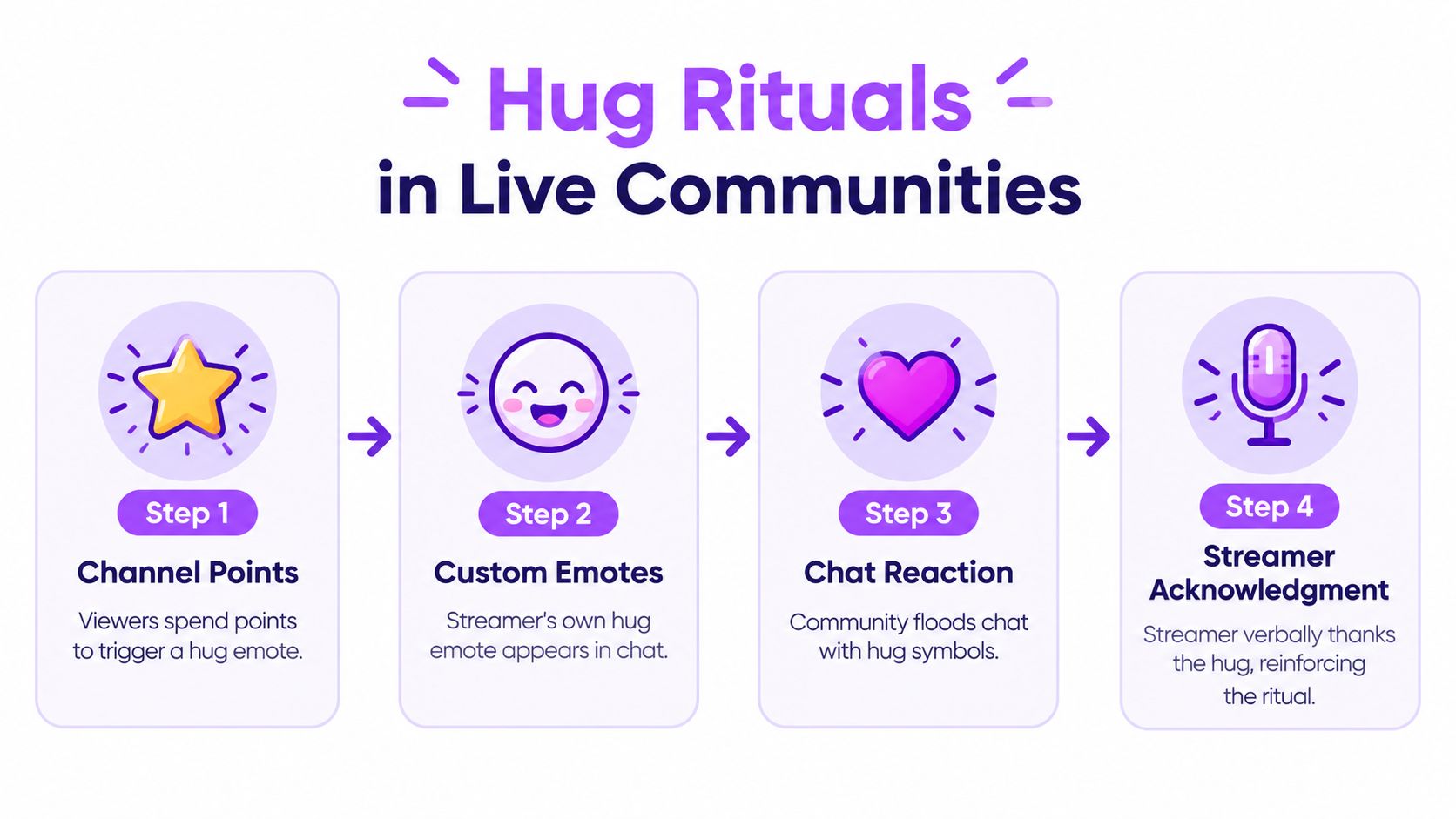
A livestream can turn a private gesture into a public ritual. A viewer writes that they’re struggling, and the streamer pauses between topics to acknowledge them. The streamer might read the message aloud, send a hug emote, and say that the viewer doesn’t have to explain everything immediately. The community then responds with familiar symbols, creating a visible group welcome.
The gesture works because several people understand the local meaning. A custom emote may represent comfort in that channel. A channel-point reward may let viewers trigger a brief on-screen hug animation. The technology provides the action, but repetition and shared expectations provide the ritual.
Three ordinary online scenes
In a Discord server, a hug channel can give members a low-pressure way to show support. Someone may post a sad update, and others respond with an emote rather than demanding details. That can be useful when the recipient wants acknowledgment but isn’t ready for a long conversation. Moderators still need to watch for unwanted intimacy and make it easy for members to decline interaction.
On TikTok or Instagram, a creator may end a vulnerable story by opening their arms toward the camera. Viewers mirror the gesture in comments, reply with hug emojis, or share the clip with someone who needs encouragement. The gesture becomes part of the content, but its meaning still depends on whether the creator gives enough context for viewers to understand the invitation.
In a chat-focused livestream, a community can respond collectively when a regular viewer experiences a loss or difficult event. The best response doesn’t turn the person’s pain into entertainment. The streamer can acknowledge the message, avoid pressing for private details, and point toward appropriate support when the situation calls for it. Understanding how Twitch chat works helps explain why these rituals depend on moderation, timing, and clear community norms.
Why public rituals need boundaries
A public hug emote can comfort someone because it lets the community say, “You belong here.” It can also overwhelm a person when dozens of messages arrive at once. Streamers and moderators should avoid assuming that every viewer wants public attention, emotional roleplay, or physical-touch language.
A healthy ritual leaves room for different preferences. Members can send a supportive sentence, remain quiet, or opt out of the emote culture without being treated as unfriendly. The visible symbol matters, but the community’s response to consent matters more.
When a Virtual Hug Helps and When It Misses
A virtual hug can carry warmth, but it isn’t automatically helpful. Reviews of mediated affective touch describe possible increases in perceived social presence, trust, affection, bonding, and prosocial behavior, while experimental work has connected computer-generated touch with changes in physiological responses such as heart-rate recovery (research on mediated virtual touch). Those findings support cautious optimism, not a universal promise.
The same research also shows why context matters. In a Scientific Reports experiment, visually represented virtual touch between human-like avatars reduced perceived closeness and social affiliation without changing physiological arousal. A gesture that seems intimate to the sender may feel uncanny, impersonal, or unwelcome to the recipient.
Situations where it can land well
A virtual hug tends to help when the relationship already includes affection and the recipient understands the sender’s intent. A close friend who has had a bad day may appreciate 🤗 followed by a specific question. A livestream community may use a familiar emote to acknowledge a regular member without forcing them to explain their feelings in public.
It can also provide recognition across distance. The sender may not be able to visit, but can still respond promptly and make a concrete offer, such as staying on a call or checking in later. The symbol becomes one part of attentive behavior.
Situations where it can miss
A grief-stricken colleague may want a direct message rather than a cheerful animated GIF. A stranger in chat may read an unsolicited hug as patronizing or flirtatious. A viewer who hasn’t opted into intimate roleplay may feel uncomfortable when an avatar or bot simulates physical contact toward them.
Research on ordinary digital touch also cautions against treating the gesture as a loneliness treatment. A study of 60 participants found that loneliness decreased after a call, but simulated touch added no further benefit, while greater real-world touch frequency was associated with lower loneliness (study of calls, simulated touch, and loneliness). The practical lesson is simple: the call and responsive relationship may matter more than the simulated embrace.
A virtual hug acknowledges a feeling. It doesn’t prove that the sender understands it.
Pair the symbol with words that show attention. “I’m sorry today has been so hard. I’m here, and I can listen if you want to talk” gives the recipient choices. The emoji can remain, but it no longer has to carry the entire emotional message.
Etiquette, Consent, and a Practical Rule of Thumb
Good virtual-hug etiquette starts with the recipient, not the feature. Before sending an intimate gesture, consider your relationship, the setting, the person’s communication style, and whether the moment calls for comfort, privacy, humor, or practical help.
Age, culture, and personal preference all shape interpretation. Research involving adults aged 40 to 79 found that communication with family and friends was associated with lower loneliness and better mental health, while communication with people known only online was associated with increased loneliness (research on online contact, loneliness, and mental health). A broader study of 1,079 adults found age differences in the relationship between virtual contact and loneliness, while face-to-face contact remained preferred across age groups, from the same source. These findings don’t mean online contact is bad. They show why a familiar relationship and meaningful follow-through matter.
A simple set of choices
- Add context: Write what you mean, especially when the subject is grief, conflict, or mental health.
- Ask rather than assume: “Would you like a virtual hug, advice, or company?” gives the recipient control.
- Respect quiet responses: No reply may mean the person needs space, not that they rejected you.
- Avoid automated intimacy: Don’t trigger hug emotes at someone during an emotional announcement without knowing their preferences.
- Follow through: Check in later, keep a promised call, or offer a specific form of help.
- Use other tools carefully: Browser-based AI chat options can provide a conversational outlet, but they shouldn’t be presented as a replacement for trusted people or professional care.
The same principles apply in livestreams and social communities. If you’re learning how to join live videos on TikTok, remember that entering a live space doesn’t automatically grant permission for personal attention, emotional roleplay, or simulated touch. Public participation and private intimacy are different things.
The most useful rule is easy to remember: the hug is the punctuation, and the message is the sentence. Send the symbol when it supports your words, choose a format the recipient can comfortably interpret, and let the person decide what happens next.
StreamGen helps creators turn livestream moments into short-form clips for TikTok, YouTube Shorts, and Instagram Reels, with AI highlight detection, vertical editing, captions, and direct scheduling in one workspace. If your community has memorable hug rituals or supportive chat moments, visit StreamGen to find and share them without losing the human context that made them matter.
More blog posts