“Fivehead” is internet slang for an unusually large forehead, originating from wordplay that replaces “four” with “five” in “forehead,” while also becoming a Twitch emote symbolizing intelligence or strategic thinking. In another context, “5 head” can refer to the number of heads assigned to a mythological Hydra.
How can one playful spelling change describe a facial feature, praise a brilliant gaming move, and point toward a regenerating monster? The answer depends almost entirely on where you encountered the term. In everyday online slang, it’s comic exaggeration. In livestream chat, 5Head often signals cleverness, either sincerely or sarcastically. In mythology, 5 head may describe a creature’s head count.
The spelling offers clues, but surrounding context matters more. A message beside a clutch game decision probably means the emote. A comment about someone’s hairline usually uses the slang meaning. A fantasy text discussing Heracles and a many-headed serpent belongs to a different vocabulary altogether.
Table of Contents
- What Does 5 Head Actually Mean
- The Slang Origin of Fivehead
- How Twitch Made Fivehead a Gaming Term
- The Hydra Connection and Classical Mythology
- Real Examples of 5Head in Streaming Culture
- Understanding Facial Perception and the Fivehead Question
What Does 5 Head Actually Mean
The most common meaning of fivehead is humorous internet slang for an unusually large or prominent forehead. The joke comes from changing “forehead” into “fivehead.” Since “fore” sounds like “four,” replacing “four” with “five” creates an exaggerated imaginary measurement, as if the forehead has somehow gained an extra unit.
That number isn’t anatomical. As Wiktionary’s definition of fivehead makes clear, the expression has no standardized measurement, clinical threshold, or universally accepted ratio. It describes a social joke, not a medical condition or objective facial category.
The same spelling becomes more specialized in gaming. 5Head is a Twitch emote and chat expression for an apparently brilliant idea, highly strategic play, or an ironic imitation of genius. The visual logic is simple: an enormous forehead suggests an enormous brain, so the caricature turns into praise.
Context usually resolves the ambiguity:
- Appearance comment: “That haircut reveals a fivehead” uses the facial-slang meaning.
- Gameplay reaction: “5Head move” usually praises an unexpectedly clever decision.
- Mythology or fantasy: “A five-headed Hydra” refers to creature lore, not internet slang.
Practical rule: Read the surrounding action, not just the spelling. The same term can be an insult, a compliment, or a mythological description.
The word can be playful between friends, but it can also become an appearance-based insult. Calling someone a fivehead comments on a visible feature without their invitation, so tone, familiarity, and setting matter. Fivehead isn’t a diagnosis, a fixed beauty standard, or proof of intelligence. It’s a flexible piece of internet language whose meaning changes with the audience.
The Slang Origin of Fivehead
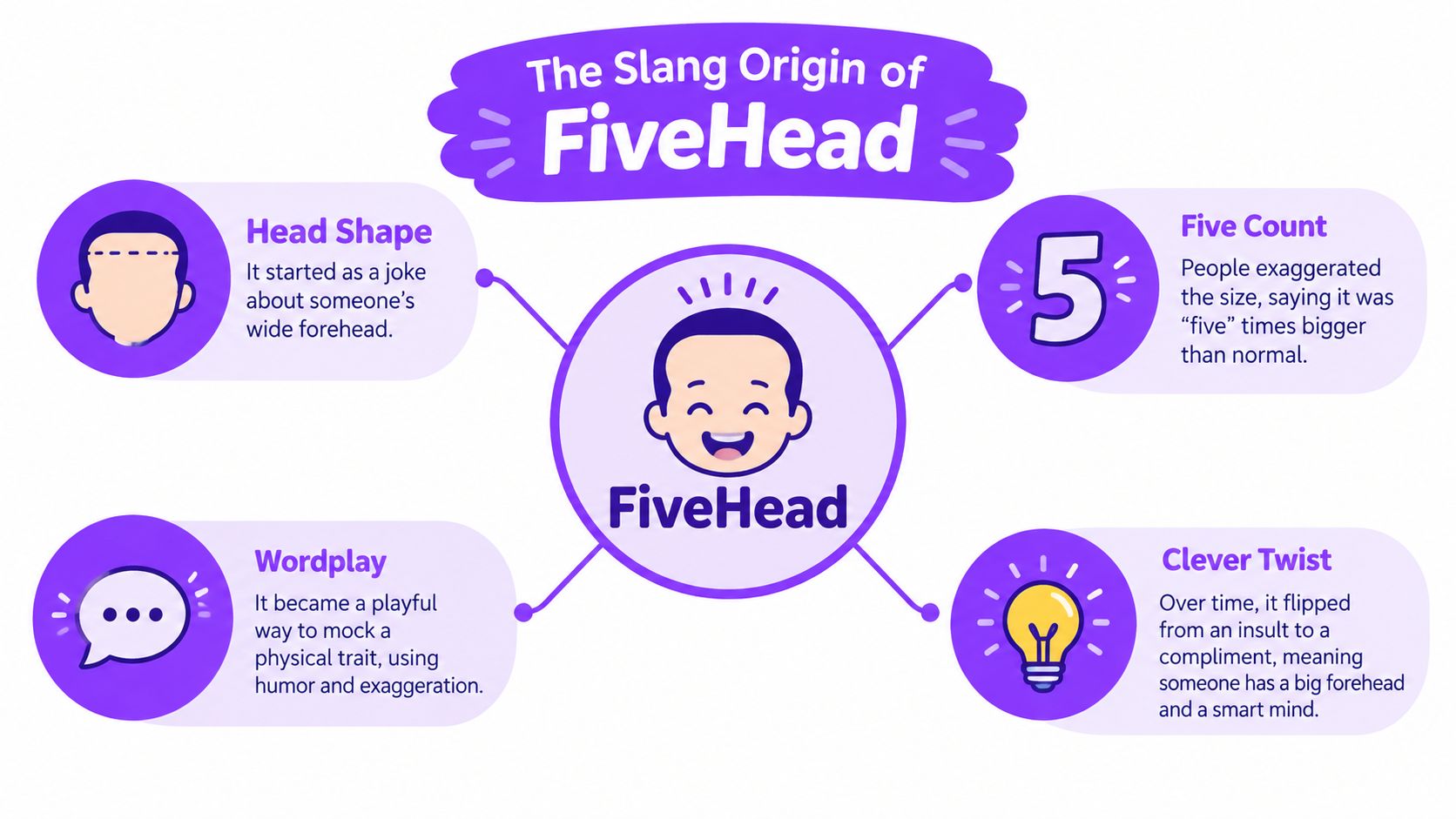
The word’s humor comes from a tiny substitution with an outsized visual effect. Start with forehead, a familiar anatomical term. Hear “fore” as “four,” replace it with “five,” and the ordinary word becomes fivehead, an exaggerated label for a forehead that appears taller or wider than average.
That construction works because internet slang often treats words as editable material. A speaker doesn’t need to invent a completely new expression. Changing one sound or number can create a joke that remains instantly understandable. The listener recognizes the original word, notices the alteration, and supplies the comic exaggeration.
The joke also carries an implied visual scale. No one needs to measure the forehead. The added “five” performs the measurement as absurdity, suggesting an extra “head” beyond the ordinary four-part pun. This is why the expression feels more playful than technical, even when it lands unkindly.
Why the joke travels easily
A slang term spreads when people can understand it without a long explanation. Fivehead has that advantage. It preserves the sound and meaning of forehead, adds a familiar number, and produces an exaggerated image in one step.
Its use still depends on social context:
- Friendly teasing can make the word affectionate.
- Public comments can turn it into appearance policing.
- Self-description can reclaim the joke or make it less threatening.
- Anonymous replies often remove the relationship cues that make teasing safe.
That social flexibility resembles other online expressions that migrate from one community to another. For a related example of slang evolving through internet culture, compare the language history discussed in this explainer on “pogger”.
The important distinction is that fivehead describes perception, not anatomy. Two people can disagree about whether someone has one, because no accepted threshold determines when a forehead becomes a “fivehead.” Hairline, hairstyle, camera angle, lighting, and facial framing can all influence the impression.
The term therefore belongs to the cultural history of online teasing rather than medical terminology. Its power comes from compression: a single altered word can communicate a visual joke, a judgment about appearance, and a relationship between speaker and listener.
How Twitch Made Fivehead a Gaming Term
Twitch transformed the forehead joke by giving it a new target. Instead of using an enlarged cranium to mock appearance, gaming communities used the same visual exaggeration to represent an enlarged brain. 5Head became shorthand for a decision that looks unusually intelligent, strategic, or several moves ahead.
Reference material traces the emote’s emergence to BetterTTV around 2018, followed by increased popularity during 2019 and associations with communities around streamers such as xQc. The image helped the meaning travel because viewers could understand the metaphor immediately: large head, large brain, clever play.
Sincere praise and comic irony
A viewer might type 5Head after a player predicts an opponent’s movement, saves a difficult round, or chooses an unexpected strategy that works. In that moment, the emote communicates admiration without requiring a full sentence. The chat has compressed “That was exceptionally clever” into one recognizable symbol.
But Twitch chat rarely leaves praise uncomplicated. The same emote can signal sarcasm when a streamer makes a questionable decision and presents it as genius. Viewers may spam 5Head because the claim is obviously overstated, not because the play deserves serious analysis.
| Chat context | Likely meaning |
|---|---|
| A successful tactical decision | Genuine praise |
| A risky move that unexpectedly works | Amused admiration |
| A poor decision defended as genius | Sarcasm |
| Repeated emote spam without a clear event | Possible group habit, bot activity, or spectators joining in |
This dual meaning is central to livestream culture. Text alone can’t always tell you whether viewers are celebrating skill or mocking overconfidence. Audio excitement, the timing of the emote, the gameplay event, and the streamer’s tone provide the missing context.
For creators analyzing their own broadcasts, 5Head works best as a contextual engagement signal. A sudden cluster of the emote alongside excited speech and a decisive gameplay moment may identify perceived strategic value. It shouldn’t be treated as definitive on its own, because viewers can use emotes repetitively, ironically, or automatically.
The cultural shift is revealing. Twitch didn’t erase the original appearance joke. It repurposed the same exaggerated forehead into a metaphor for intelligence, proving that meme meanings often depend less on a fixed definition than on a community’s shared visual grammar.
The Hydra Connection and Classical Mythology
Not every “5 head” reference belongs to internet culture. In mythology, five head can describe a Hydra assigned five heads, although ancient and later accounts disagree substantially about the creature’s exact number. Reported versions range from five to more than 100, while the best-known classical account commonly gives nine, as described in this overview of Hydra mythology.
The Hydra’s defining feature isn’t only its appearance. Its danger comes from regenerative multiplication. When one head is severed, two are said to grow back, unless the wound is cauterized or otherwise prevented from regenerating. That detail makes the creature a symbol of problems that multiply when someone attacks them carelessly.
Three meanings, one spelling
The mythology meaning usually appears in a different linguistic environment from the Twitch meaning. Words such as Lernaean, Heracles, monster, heads, or regeneration point toward classical or fantasy writing. Words such as chat, emote, streamer, play, or clutch point toward livestream culture.
A classification system should therefore avoid assigning meaning from the token alone. The same phrase might appear in a fantasy game, a mythology lesson, a transcript, or a chat overlay, and each setting demands a different interpretation.
| Meaning | Main subject | Context clues |
|---|---|---|
| Fivehead slang | Facial appearance | Hairline, face, teasing |
| 5Head emote | Intelligence or strategy | Twitch, chat, gameplay |
| Five-headed Hydra | Mythological creature | Heracles, regeneration, fantasy |
The Hydra interpretation is unrelated to the forehead pun and the Twitch emote. The shared number and head imagery create a surface resemblance, but the histories diverge. Treating them as one definition produces exactly the confusion that context is meant to resolve.
Real Examples of 5Head in Streaming Culture
Consider a tactical game in which a streamer appears trapped. Instead of taking the obvious escape route, they pause, bait an opponent into moving, and reverse the situation. Chat fills with 5Head because viewers read the moment as deliberate, intelligent decision-making.
Now change the outcome. A streamer rushes into danger, loses valuable resources, and immediately calls the move “calculated.” Chat responds with the same emote, but the meaning flips. The viewers aren’t necessarily praising the decision. They’re exaggerating the streamer’s self-description for comic effect.

Reading the signal around the emote
A useful interpretation combines the message with what happened immediately before it. Chat behavior can provide a strong clue, but it can’t settle intent by itself.
- Timing matters: A burst immediately after a successful play carries more evidential weight than isolated usage.
- Audio adds tone: Excited reactions may support sincere praise, while laughter or self-mocking delivery may suggest irony.
- Gameplay supplies the event: A prediction, trap, rotation, or unusual solution gives the emote something concrete to reference.
- Repetition needs caution: Spectators, habitual chatters, and bots can repeat an emote without evaluating the play.
This is why chat analysis can complement, rather than replace, gameplay and audio analysis. A system that only searches for the word may find spam. A system that combines 5Head activity with event timing, vocal energy, and visible decisions has a better chance of identifying moments viewers perceive as skillful.
Creators building a repeatable short-form workflow can also learn from LesFM’s virality playbook, especially its emphasis on understanding why a moment earns attention rather than treating every loud clip as equally valuable. For locating promising sections inside long broadcasts, a dedicated Twitch clip finder can make that discovery process more systematic.
The emote’s usefulness lies in its density. One symbol can communicate admiration, disbelief, mockery, and group participation. To understand which emotion is present, read the surrounding conversation and watch the moment that triggered the response.
Understanding Facial Perception and the Fivehead Question
The joke often carries an unspoken assumption: that a larger forehead must make someone less attractive. That conclusion is too simple. The word fivehead describes a comic perception, not an objective attractiveness score, and facial judgments involve relationships among features rather than one isolated measurement.
A 2025 eye-tracking study reported that viewers concentrated most on the central facial triangle, including the eyes, nose, and mouth. In that study, greater attention to the forehead was associated with lower attractiveness ratings, while hair and the mouth or eyes were stronger factors depending on the viewer and the faces assessed, as summarized by PsyPost’s coverage of the study.
That finding doesn’t show that forehead size causes lower attractiveness. Gaze may reflect hairstyle, facial framing, age cues, or the balance of the entire face. A camera can also change the apparent proportions of a person’s features, particularly when the lens, angle, distance, lighting, or crop changes.
What creators can control
For someone appearing on livestreams or short-form video, neutral presentation choices may matter more than arguing over the label. A creator can test framing and styling without accepting the idea that a forehead is a defect.
- Camera height: A camera placed too low or too close can change facial proportions.
- Lighting direction: Strong overhead light can emphasize contours that softer front lighting minimizes.
- Hair and headwear: Hairline visibility, bangs, caps, and hats alter the frame around the face.
- Cropping: A tight vertical crop can make one facial region appear more dominant.
- Consistency: Comparing clips under similar conditions gives a more useful impression than judging a single frame.
If you’re choosing headwear for comfort or fit, a practical sizing guide for custom hats focuses on measurement rather than appearance-based teasing. For camera setup and visual consistency, the best webcams for streamers offer a more constructive starting point than trying to diagnose your face through meme vocabulary.
The sensible answer to “does having a fivehead make someone less attractive?” is that the term itself can’t answer the question. Perception varies, and presentation changes what viewers notice. Use the word as a clue to cultural context, not as a scientific judgment about a person’s face.
StreamGen helps creators turn long Twitch broadcasts into short-form clips by detecting gameplay, reactions, chat, and audio signals, then editing and scheduling the strongest moments for TikTok, YouTube Shorts, and Instagram Reels. If 5Head reactions mark the moments your audience finds strategically compelling, visit StreamGen to find and publish those highlights more efficiently.
More blog posts