You publish a clip that performs better than usual. Soon, the comments fill with “Love this,” “You’re amazing,” and “Check my bio.” Some profiles have no clear identity, several comments appear within minutes of one another, and one account claims to represent a familiar creator or brand.
That feels like a pleasant surge of attention, but a fake comment on Instagram can do more than inflate a visible number. It can distort your understanding of audience interest, weaken trust in your community, or steer viewers toward phishing pages and malware. The difficult part is that many fake comments look ordinary, especially when they use friendly language.
The right response isn’t to distrust every enthusiastic viewer. It’s to separate two different risks: vanity-metric manipulation, where coordinated accounts manufacture social proof, and social-engineering scams, where comments persuade people to click, pay, or disclose information. Once you treat those as related but distinct problems, detection and response become much clearer.
Table of Contents
- A Strange Comment Under Your Best Clip
- What Counts as a Fake Comment on Instagram
- Where Fake Comments Actually Come From
- How Hard It Is for Humans to Spot a Fake Comment
- A Multi-Signal Way to Tell Real From Fake
- When Fake Comments Are Actually Scams
- Reporting, Removing, and Reducing Future Fake Comments
A Strange Comment Under Your Best Clip
Your best clip has just taken off. Viewers are replying to one another, sharing their own reactions, and asking questions about how you made the moment. Then a cluster of unfamiliar accounts appears. One praises the clip without mentioning anything specific, another directs people to a bio, and a third offers a prize or support message.
The comments may not look dramatic enough to remove immediately. A generic “Great content” could come from a real viewer who watched while scrolling. A person might genuinely use a string of emojis. A small account might be new because its owner has only recently started participating on Instagram.
The problem emerges when the comment is viewed as part of a pattern rather than as an isolated sentence. Several accounts may repeat similar praise across unrelated creators, arrive in a synchronized burst, or use profiles that appear designed for one narrow purpose. A comment that seems harmless alone can become meaningful when it sits beside matching activity from connected accounts.
Practical rule: Treat a suspicious comment as a clue, not a verdict.
Creators should care because comments shape perception. New visitors often use visible conversation as a shortcut for judging whether an account is active, credible, and worth following. Brands may also review engagement quality before discussing a collaboration. If artificial activity changes those impressions, the damage reaches beyond a single post.
There’s a safety risk too. A fake comment may be trying to move viewers away from Instagram, imitate a creator, announce a false giveaway, or collect credentials. That’s why deleting obvious spam is only one part of the job. You also need a way to assess the account behind the comment, the timing of the activity, and the action the commenter wants people to take.
What Counts as a Fake Comment on Instagram
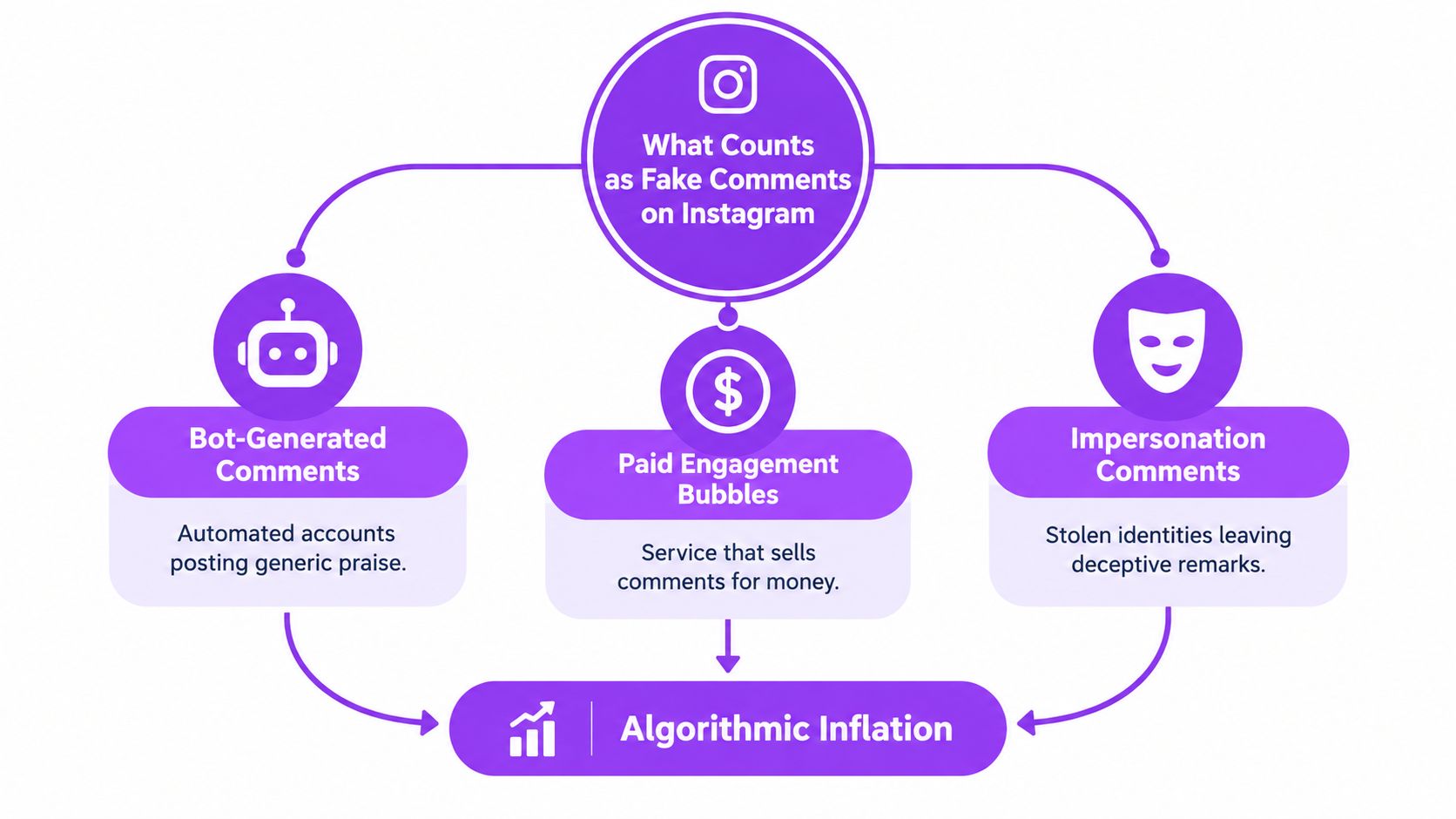
A fake Instagram comment is a comment produced or coordinated to create a misleading impression, promote an artificial engagement service, impersonate someone, or direct users toward a harmful action. The wording can be automated, manually posted, or copied from a template. What makes it deceptive is the purpose and surrounding behavior, not poor grammar alone.
Three broad forms appear in practice:
- Bot-generated comments come from automated or semi-automated accounts. They often use broad praise that can fit many posts.
- Paid engagement comes from services or networks that deliver comments to make a post appear more popular.
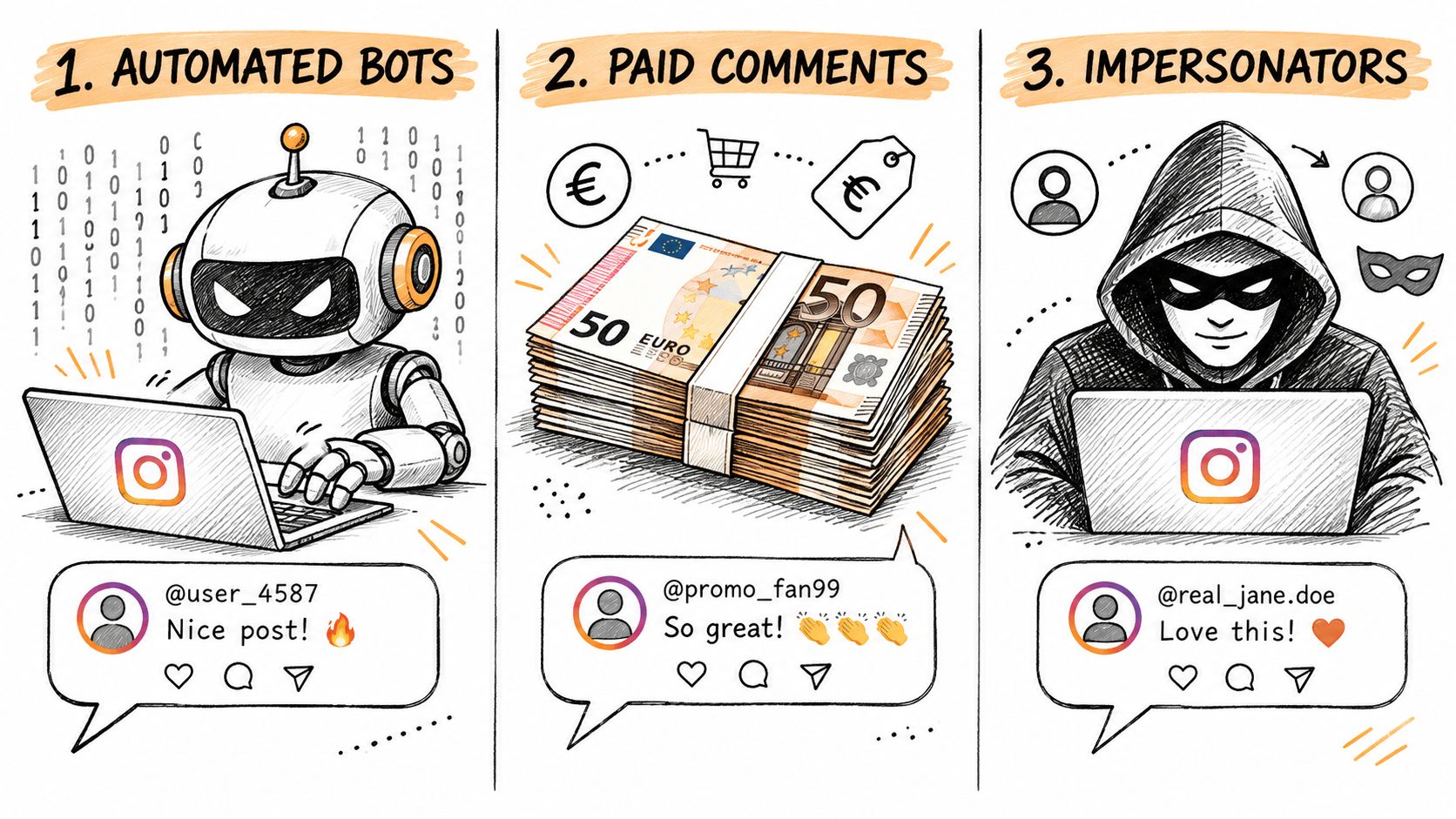
- Impersonation comments use a copied name, image, or identity to make a message seem connected to a creator, platform, brand, or support team.
A peer-reviewed-style study collected Instagram activity over seven months, covering 3,800 impersonator accounts, 4,800 comments, 2,600 likes, and 566 unique posts in its dataset (the Instagram impersonation study). The activity wasn’t evenly distributed. Impersonator accounts concentrated comments around a limited set of community posts, while likes spread more broadly.
That difference helps explain why comments deserve closer attention. A like can be distributed mechanically, but a comment has to appear relevant enough to support a believable conversation. Coordinated operators may therefore focus comments where visible discussion can make an account or post seem socially credible.
This doesn’t mean every generic comment is fake. It means authenticity usually sits in the behavior around the message. Look at who posted it, what else that account does, whether related profiles behave similarly, and whether the comment asks viewers to take an unusual action.
The study isn’t a platform-wide estimate of fake activity. It does, however, show that impersonation networks can operate at organized scale and persist over time. For creators, that distinction matters: a suspicious comment section may reflect a campaign rather than a few unrelated spammers.
Where Fake Comments Actually Come From
Many picture a robot producing a sentence and posting it under a trending video. That’s one source, but fake comments also come from paid networks and from gaps between what automated moderation can recognize and what a human can understand.
Automated accounts
Bots can search for posts connected to a topic, creator, or trend, then publish a prepared response. Their language may be repetitive, but it can also be varied enough to avoid simple keyword filters. An account might alternate between praise, emojis, questions, and prompts to visit a profile.
Automation becomes more useful to an operator when it can imitate normal timing and interaction. Instead of posting everywhere at once, a network can distribute activity across selected posts. That makes a single comment look less suspicious while preserving the larger campaign’s goal.
Purchased engagement
Paid engagement is different because the person or service ordering the activity may not control the accounts directly. A customer might pay for comments, while a broker uses a mixture of automated profiles, recycled accounts, or recruited workers to deliver them.
The comments can look more custom than bot output, but the underlying engagement still lacks genuine interest. A paid commenter may praise a gaming clip without referring to the actual play, ask viewers to follow an unrelated account, or leave similar language across several communities.
A hybrid research study found that bots represented 8.87% of comments in its analyzed discourse (the Instagram bot classification research). That figure describes the study’s analyzed discussion, not all Instagram comments. It illustrates why occasional spot checks won’t reveal every artificial pattern.
Moderation gaps
Moderation systems are good at obvious repetition and known abusive terms, but context changes the meaning of a message. “Check my bio” might be harmless in one community and a phishing path in another. A supportive comment can also hide an impersonation attempt if the profile presents itself as a creator or platform representative.
Creators can reduce exposure by combining platform controls with account review. Teams dealing with repeated automated abuse may also benefit from guidance on mitigation strategies for scripted abuse, especially when the activity appears coordinated rather than isolated.
A practical content workflow should include a review point before suspicious engagement influences reporting or publishing decisions. For creators who distribute clips across several channels, automating social media posting can make consistency easier, but automation should never mean automatically trusting every response that appears after publication.
How Hard It Is for Humans to Spot a Fake Comment
Your instincts aren’t failing if a convincing fake comment gets past you. Friendly and neutral messages are deliberately difficult to classify because they resemble ordinary approval and don’t give readers an obvious reason to become suspicious.
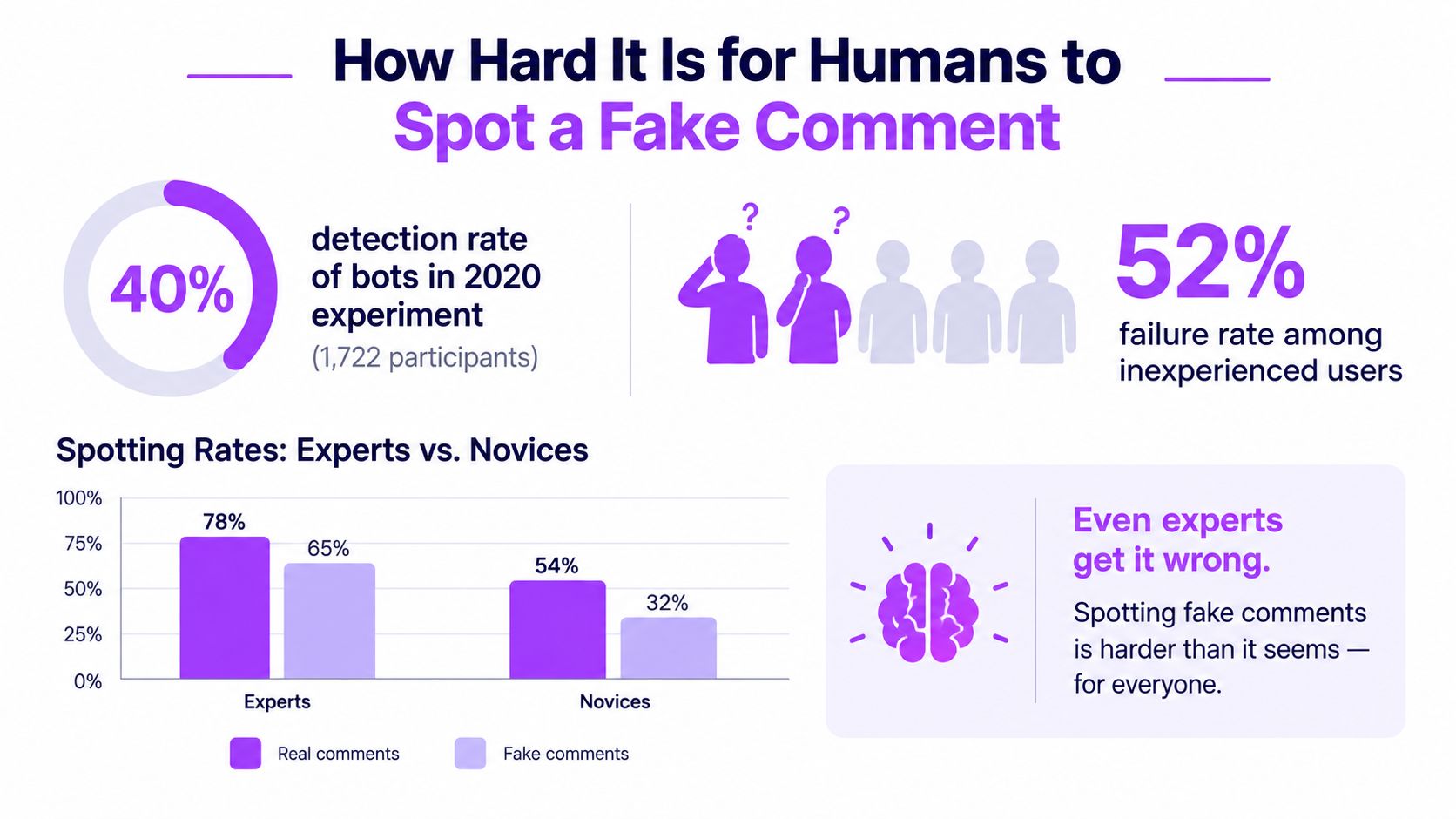
In a 2020 global bot-detection experiment with 1,722 participants, users identified only 40% of the bots shown to them, while 52% performed below the study’s overall success threshold (the bot-detection experiment). Negative or argumentative bots were easier to recognize than supportive or neutral ones. That finding matches everyday experience. A hostile message attracts scrutiny, while “This is so good” usually doesn’t.
Emoji use offered a partial clue, not a reliable test. Participants detected emoji-heavy comments 66.3% of the time, compared with 35.7% for comments using few emojis, according to the same experiment. Real users also use emojis, and advanced accounts can change their style, so emoji frequency should support a decision rather than determine it.
Start with the profile
Open the account before deciding what to do. Check whether the profile has a coherent identity, a completed biography, original posts, and a history that makes sense for the community. An empty profile isn’t proof of abuse, but it gives the comment less independent credibility.
Then inspect the account’s relationships. A strange follower-to-following ratio, repeated comments under unrelated creators, and very little genuine interaction can be more informative than the sentence itself.
| Signal | What to look for | Why it matters |
|---|---|---|
| Profile quality | Little biography, copied imagery, or sparse history | The account may exist mainly for outreach or automation |
| Relationship pattern | Abnormal follower-to-following balance or unrelated creator activity | Broad, disconnected activity can indicate a network |
| Timing | Many similar comments immediately after publication | Synchronized bursts suggest coordination |
| Language | Generic praise, repeated phrasing, or an unexplained call to action | The message may be templated or designed to redirect attention |
| Volume | More commenting than the profile’s normal activity would suggest | Unusual output can point to automation or paid work |
Don’t punish a person solely because their comment is short or enthusiastic. Use the visible message to decide whether to inspect the account, not whether to label its owner with certainty.
A Multi-Signal Way to Tell Real From Fake
The strongest approach treats detection as a classification problem, not a keyword hunt. A research study on coordinated Instagram traffic reported a semi-supervised model with a 95% F1 score when it combined profile and behavioral characteristics, and testing across 20 accounts with more than one million followers found that over 20% of observed engagement was artificial (the coordinated-traffic study). Those results don’t give an individual creator a magic threshold. They show why several modest clues can become powerful when they point in the same direction.
Score the account and the event separately
Start with two questions:
- Does the account look trustworthy?
- Does this particular activity look coordinated?
An account may be incomplete but still genuine. A well-designed profile may still participate in a campaign. Separating account risk from event risk prevents one weak signal from triggering an unfair removal.
| Signal | What to Look For | Why It Matters |
|---|---|---|
| Account age and completeness | A newly created or barely completed profile | A disposable identity is easier to abandon after a campaign |
| Follower-to-following ratio | An unusual imbalance paired with aggressive commenting | The account may prioritize outreach over community participation |
| Repetition across creators | Similar comments under unrelated accounts | Reuse suggests a campaign, template, or paid task |
| Posting timing | Several accounts arrive soon after the same post goes live | Synchronized activity is stronger than one fast comment |
| Comment volume | High output compared with the account’s normal activity | The profile may be automated or operated for engagement delivery |
| Interaction diversity | Comments without meaningful replies, shares, or ongoing discussion | One-way activity can indicate manufactured participation |
You can use a simple internal risk score without pretending it is a perfect verdict. For example, record one concern for each signal, then send accounts with several concerns to review. Keep a human decision for borderline cases, especially when the comment doesn’t contain a link or deceptive request.
Read the intention, not just the sentiment
A positive comment can still be dangerous. Sentiment analysis might classify “You won a prize, check your bio” as positive, but emotional tone doesn’t tell you whether the action is safe. If your team is comparing tools for sentiment analysis techniques, treat that analysis as one input, not an authenticity detector.
The better question is, “What does this comment want the viewer to do?” Genuine reactions usually connect to the content. Suspicious comments often redirect attention to a profile, external page, private message, payment request, or account-recovery process.
This matters for high-volume creators. A tool that helps produce more clips, such as an AI video clipper, can increase the number of posts that need review. Build moderation into the publishing routine. Save timestamps, account details, repeated phrases, and screenshots before removing coordinated activity, especially if the comments may support a fraud report.
One generic comment is weak evidence. A repeated pattern across profiles, timing, and intent is much stronger.
When Fake Comments Are Actually Scams
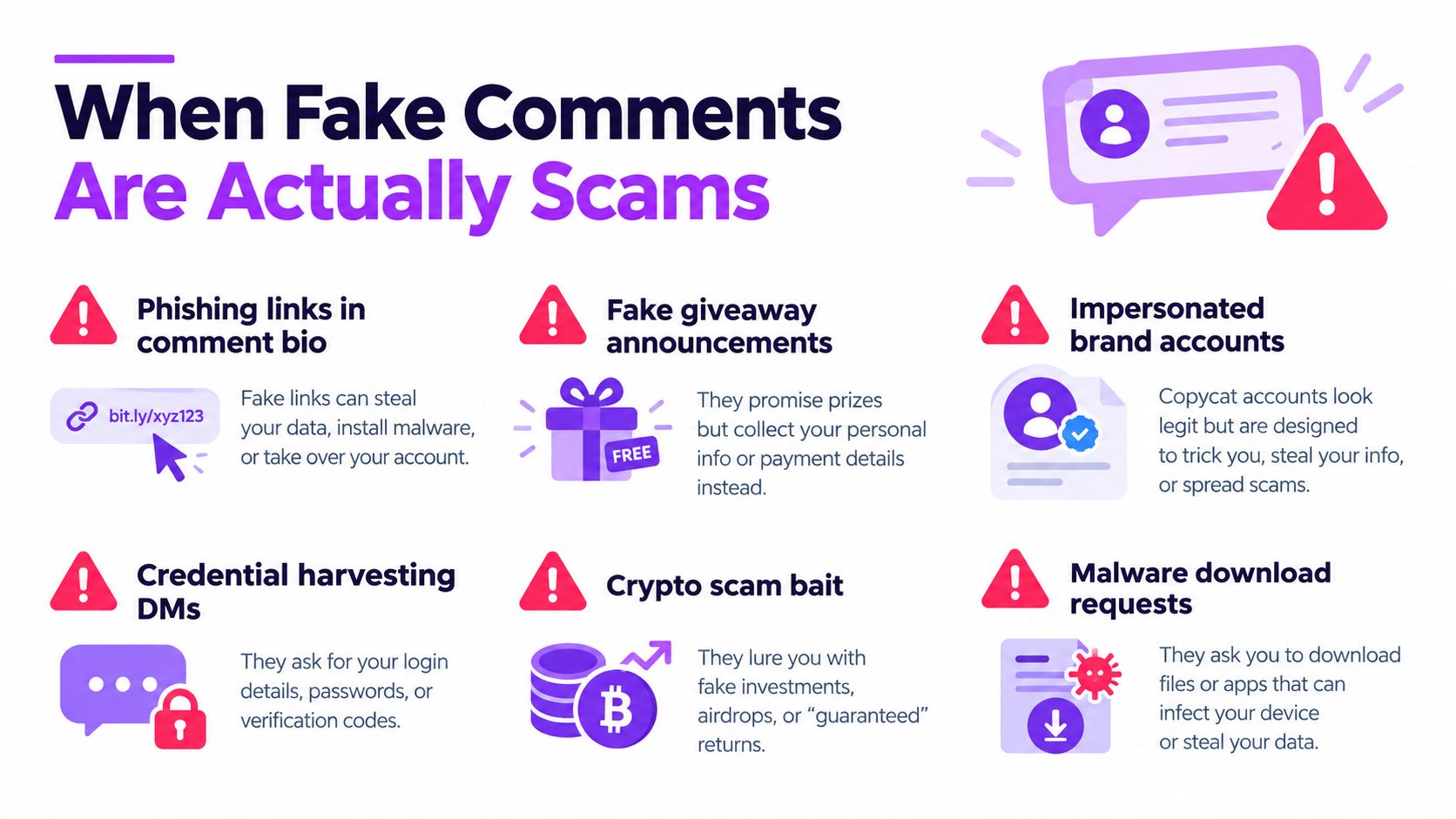
Some fake comments aren’t trying to make a post look popular. They’re trying to make a viewer act before thinking. The comment may promise a prize, announce a giveaway, imitate Instagram or the creator, or direct people to an unknown link.
A recent security analysis identified recurring patterns in malicious Instagram comments, including prize promises, instructions to check a bio, impersonation of Instagram or a creator, and unknown links used in phishing or malware campaigns (the security analysis of malicious Instagram comments). A comment can therefore look like ordinary engagement while functioning as an advertisement for a trap.
Pause before you follow the instruction
Don’t click a link supplied by a random commenter. If the message claims to come from a creator, sponsor, tournament, or platform, leave the comment and go directly to the official profile or website. Check whether the announcement appears there through a trusted channel.
Urgency is a major warning sign. “Act now,” “your account will be deleted,” “you’ve won,” and “send your details to claim” all try to replace verification with pressure. A legitimate promotion can still have a deadline, but you should be able to confirm it without relying on the suspicious comment.
Gaming creators and streamers should be especially careful with fake sponsor offers, tournament announcements, account-recovery messages, and viewer-support appeals. A scammer can copy familiar branding and place the message beneath a viral clip, where the surrounding audience makes the account seem more credible.
If you already interacted
If you only replied, stop the conversation and avoid sharing further information. Remove the reply if it exposes personal details, then report the comment and account through Instagram’s menu. If you entered a password on an external page, change it immediately from a trusted device, enable two-factor authentication, and review active login sessions.
If you submitted payment or financial information, contact the bank or payment provider through its official channel. Preserve screenshots, usernames, profile links, messages, and the suspicious URL before blocking or deleting anything. Evidence helps you explain what happened and helps the impersonated creator or brand warn its audience.
Use comment filters to catch obvious patterns, but don’t rely on them to validate a claim. Filters can hide a phrase. They can’t prove that a giveaway is real, that a support account belongs to Instagram, or that a payment destination is legitimate.
Reporting, Removing, and Reducing Future Fake Comments
Start with the least destructive action that protects your audience. Report comments that appear fraudulent, malicious, or impersonating another account. Hide or remove clear spam, and restrict accounts when you want to limit their visibility and interaction without immediately escalating the situation.
Blocking cuts off the account more decisively. Restricting is useful when you want to reduce contact while preserving a quieter review path. The exact controls and menu labels can change, so consult a current guide on how restricting compares to blocking before choosing the response that fits your situation.
Build a repeatable moderation routine
After each high-performing post, review the earliest comments and any sudden cluster that includes a link, prize claim, account warning, or request to move into direct messages. Record recurring usernames, phrases, profile images, and timing patterns. A simple log helps you recognize the same campaign when it returns under another post.
Use Instagram’s comment controls, hidden-word filters, and manual review options to reduce obvious abuse. Keep the rules narrow enough that genuine questions and community conversation remain visible. Broadly hiding all short praise can frustrate real viewers and remove useful signals about what your audience enjoys.
For teams managing live communities, the same discipline applies to Twitch chat moderation. Review suspicious activity before using comment volume as evidence of content performance, partnership value, or audience demand.
Protect the account after an incident
If someone on your team clicked a suspicious link, treat it as an account-security event. Change exposed passwords, review login activity, revoke unfamiliar access, and turn on two-factor authentication. Don’t reuse a password that appeared on the suspicious page.
Creators and brands should also audit engagement before making decisions. Look for repeated accounts, synchronized bursts, unrelated comments, and followers who never show meaningful interaction. A high visible count can be misleading if the underlying audience doesn’t respond naturally.
The goal isn’t perfect detection. It’s a process that catches obvious scams, reduces coordinated manipulation, protects legitimate viewers, and leaves a clear record when a more serious report is necessary.
StreamGen helps creators turn long Twitch broadcasts into short-form clips, edit them for vertical feeds, and schedule distribution to Instagram Reels, TikTok, and YouTube Shorts. If you’re building a larger publishing rhythm and want content operations that keep pace with moderation, visit StreamGen to explore the workflow.
More blog posts